



Highlights
- Program Completion: A total of 962 metres were completed across four (4) reconnaissance drill holes at the Upper Prawn Lake, Southside, and Crab Lake target areas (Please see Figure 1).
- Anomalous Radioactivity: Multiple intervals of anomalous* radioactivity exceeding 300 counts per second (“cps”) were intersected in three (3) of the four (4) holes, totalling 1.5 metres of composite radioactivity. Geochemical assays are pending.
- Geophysical Correlation: The intersection of graphitic metasediments and associated sulphide mineralization in all four (4) holes validates the Project’s electromagnetic (“EM”) signatures and confirms the accuracy of the current geophysical model. Significant graphitic sequences are confirmed in ROC-26-001 (0-76 m) and ROC-26-003 (36-84 m), with graphitic fault gouge also present in ROC-26-004.
- Structural Corridors: Brittle graphitic structures and clay gouge indicate structural reactivation and the conduits necessary for mineralizing fluids. Secondary hematite and clay alteration confirm hydrothermal processes – a key indicator for uranium deposition.
- Future Work: A phase two drilling program is currently being designed to follow up on this reconnaissance work. The integration of these latest results will refine and test additional regional targets across more than five (5) km of untested conductor strike-length.
VANCOUVER, B.C. – COLLECTIVE METALS INC. (CSE: COMT | OTC: CLLMF | FSE: TO1) (the “Company” or “Collective”) is pleased to announce that drilling activities have been completed at the Company’s Rocas Uranium Project (“Rocas”, or the “Project”) located seventy-five (75) kilometers southwest of the Key Lake Mine and Mill facilities along Highway 914. The inaugural drilling program targeted anomalies derived from the 2025 prospecting results and integrated geophysical data, including recent ground gravity and historical VTEM anomalies. The Project is currently under a three-year earn-in option agreement (the “Option Agreement”) with Standard Uranium Ltd. (“Standard”).
Christopher Huggins, Chief Executive Officer of the Company, commented, “The completion of our inaugural drill program at Rocas marks an important step in advancing what we believe is a highly prospective uranium system. Intersecting anomalous radioactivity alongside reactivated graphitic structures across multiple targets validates our exploration model and reinforces the scale potential of the Project.”
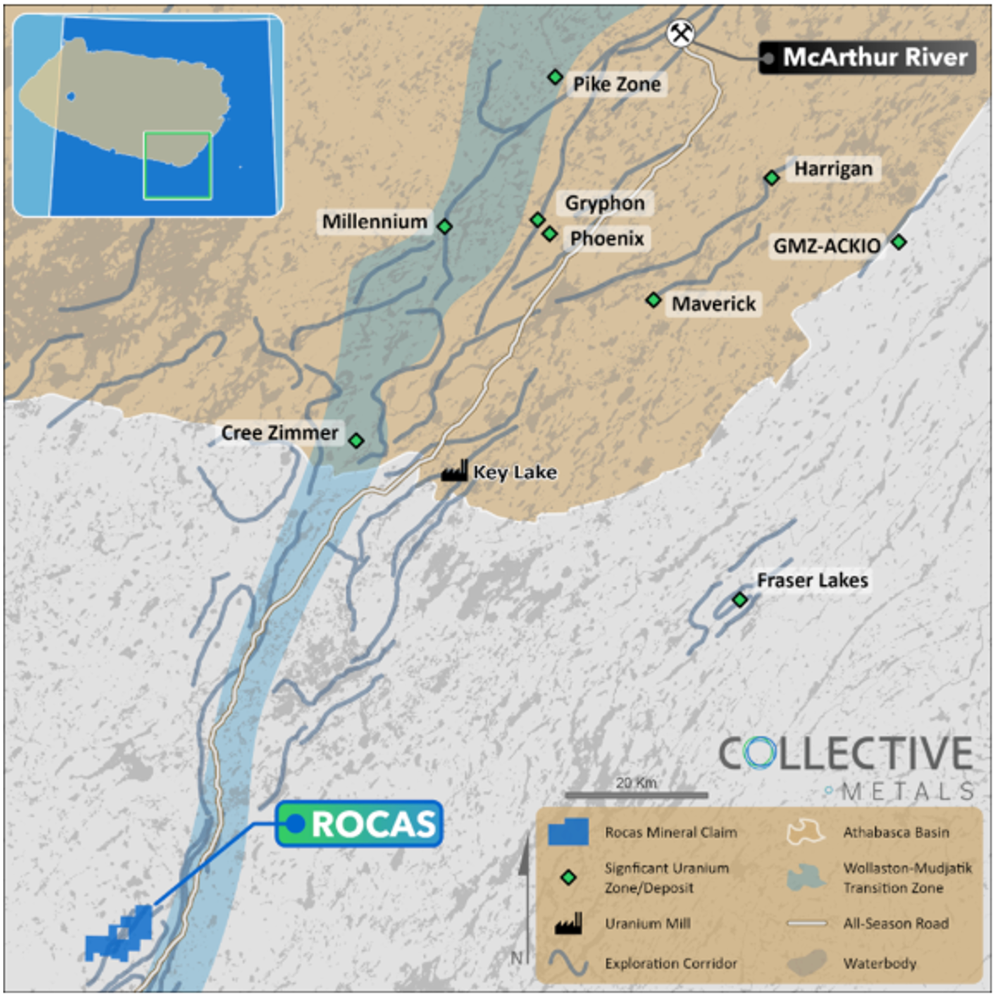
Figure 1. Regional overview of the Rocas Project along Highway 914
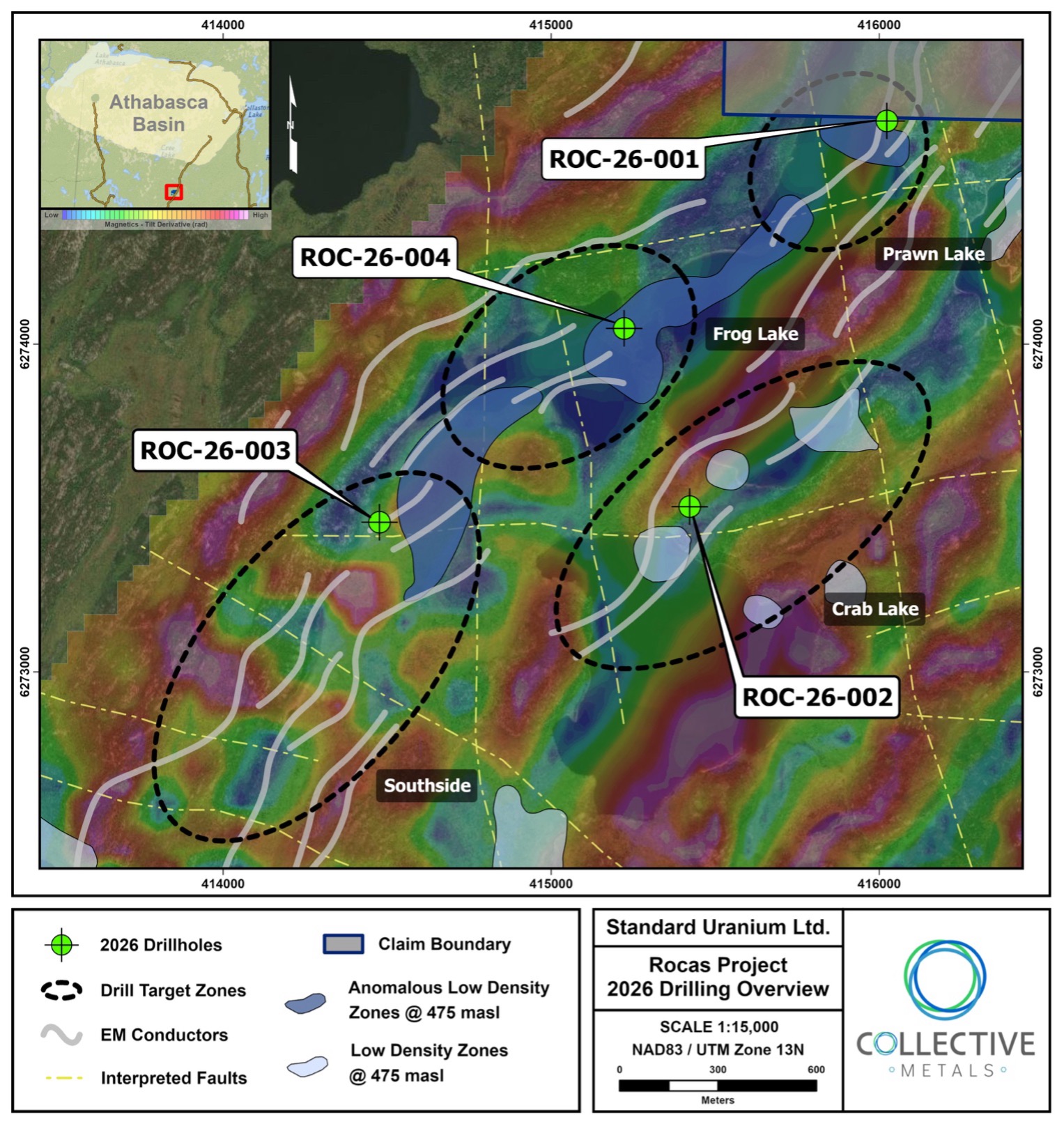
Figure 2. Rocas Project overview, highlighting target areas tested during the 2026 drill program
2026 Drill Program – Preliminary Results
The winter drilling program (the “Program”) totaled 962 meters across four (4) reconnaissance drill holes. Three (3) holes intersected anomalous* radioactivity and all four (4) contain reactivated graphitic structures. This inaugural Program tested three (3) high-priority target areas identified by integrating 2025 ground gravity data, historical VTEM electromagnetics, and surface geological information and mineralization recorded during the 2025 prospecting program.1 Radiometric results and drill hole data are provided in Table 1.
The four (4) completed drill holes encountered highly favorable geological settings for basement-hosted uranium deposits, including:
- Graphitic metasediments: Combined intersection downhole thickness of 114 m across all four (4) drillholes, including local fault zones featuring brittle reactivation and graphitic fault gouge, breccias, and cataclasites. Most notable is a 9-metre graphitic fault zone in ROC-26-003 (73-82 m) characterized by dark charcoal-gray cataclastic matrix with 5-10 cm graphitic fault gouge intervals and minor pyrite and pyrrhotite – a highly prospective structural setting for uranium. Accompanying clay alteration and hydrothermal hematite observed locally.
- Hydrothermal Alteration: Key alteration includes clay replacement, chlorite, carbonate, and secondary hematite in and surrounding the above-mentioned graphitic fault zones, providing evidence of the hydrothermal processes required for uranium deposition.
- Anomalous Radioactivity: Multiple intervals of anomalous* radioactivity, with notable intersections including 0.5 m up to 360 cps in ROC-26-003 (40.5-41.0 m), 0.5 m up to 320 cps in ROC-26-004 (71.0-71.5 m), and 0.5 m at peak 650 cps in ROC-26-001 (208.5-209.0 m) totalling 1.5 metres of composite anomalous radioactivity.
Table 1. Winter 2026 Rocas drilling radioactivity results

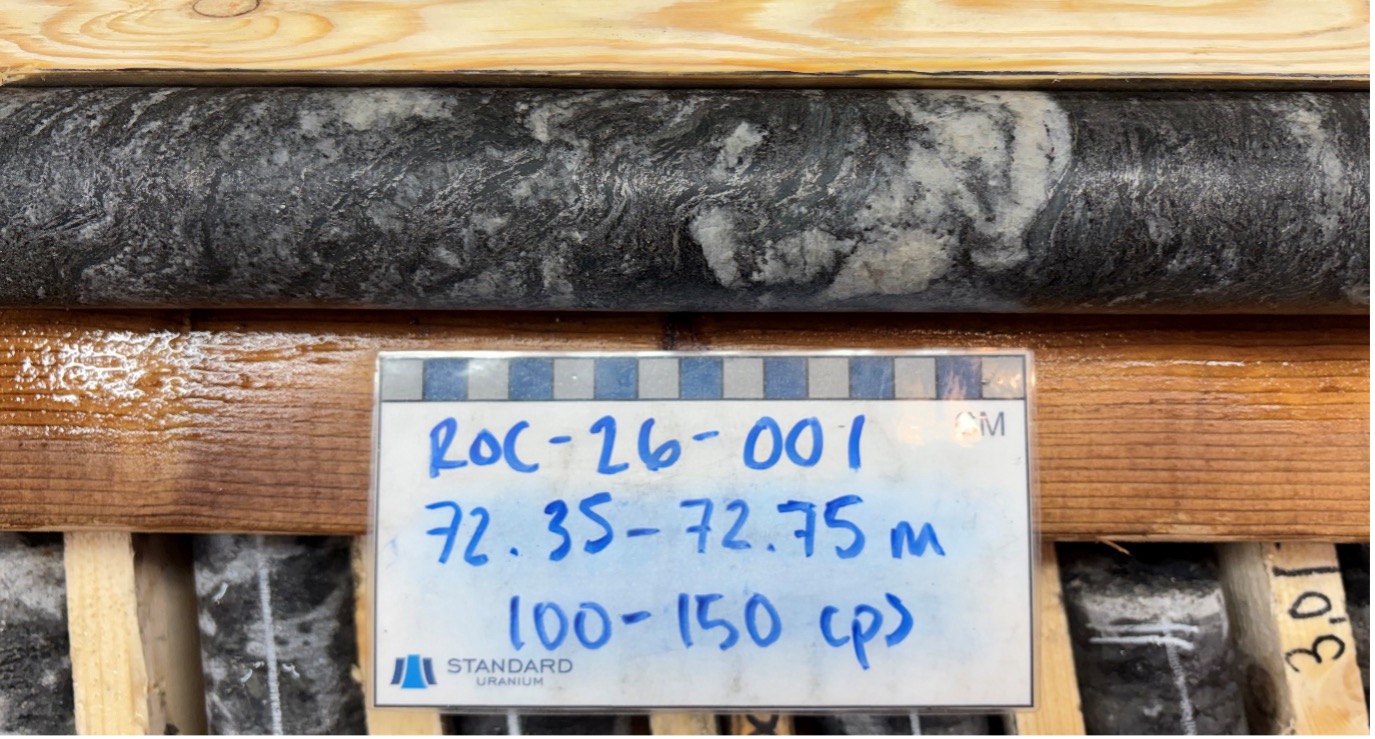
Figure 3. Drill core photo of chloritized graphitic pelitic gneiss in ROC-26-001
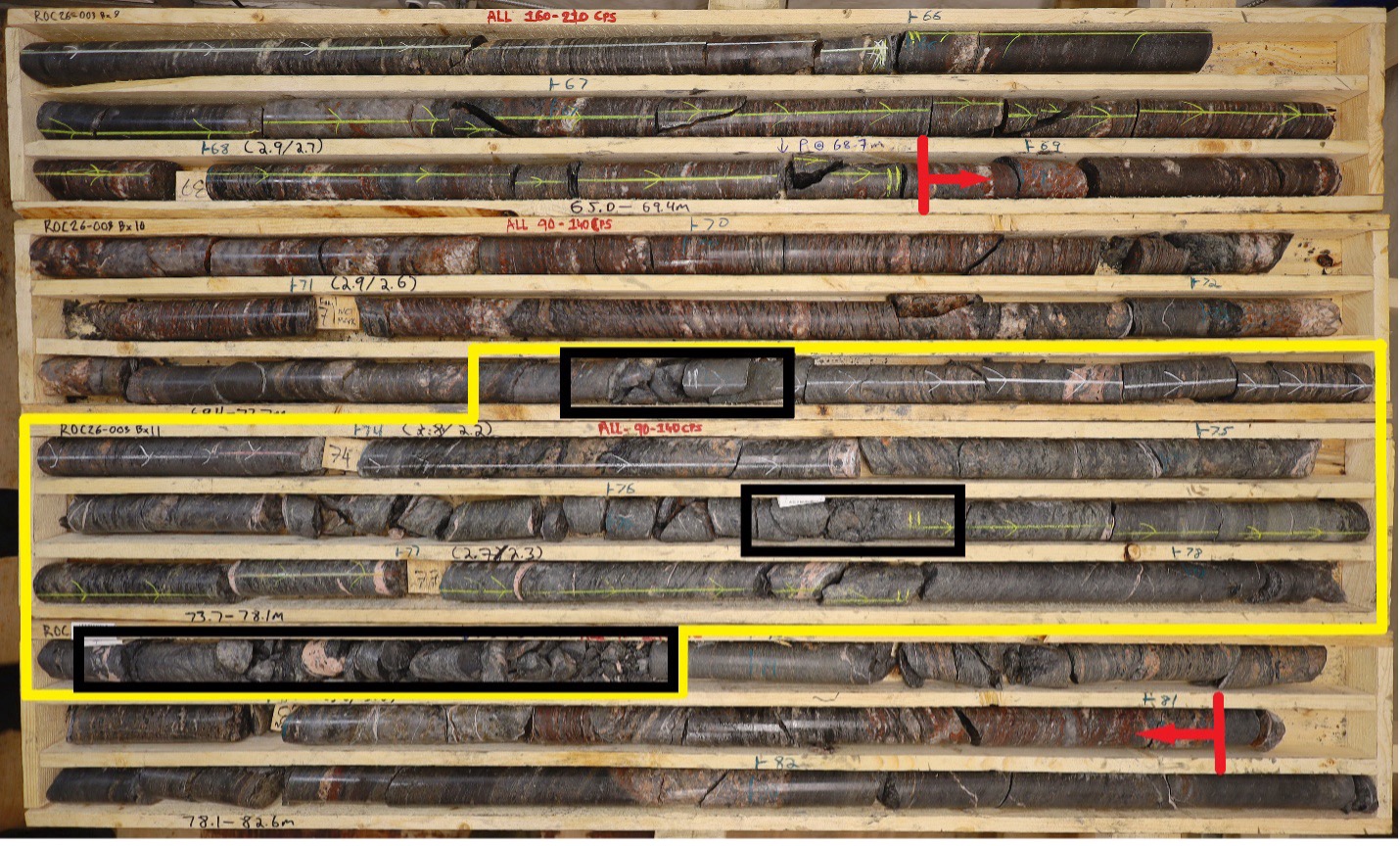
Figure 4. Drill core photo from ROC-26-003: Clay-altered graphitic pelitic gneiss (yellow), with reactivated gouge/cataclasite intervals (black), carbonate veining, and bounding hydrothermal hematite alteration (red)
Next Steps & Follow Up
Building on the success of the 2026 Program, the Company and its partner, Standard Uranium Ltd., are planning follow-up activities to expand upon recent results:
- Regional Prospecting: Continued mapping and sampling will be conducted on radioactive anomalies identified during the 2025 season to refine drill targets.
- Systematic Corridor Testing: Future drilling will move systematically along the remaining untested 5 km of the 7.5 km EM corridor, focusing on extrapolated conductors and areas with anomalous geochemistry and surface Uranium/Rare Earth Element mineralization.
- Geophysical Expansion: The Company intends to expand ground gravity and EM coverage to the north and south of the current target areas to identify additional structural offsets and traps for uranium mineralization.
Drill core samples have been collected systematically for whole-rock multi-element geochemical analysis and submitted to SRC Geoanalytical Laboratories in Saskatoon for U3O8 and Rare Earth Element (“REE”) assay. These results will be integrated with detailed logging and structural modelling to prioritize follow-up target areas.
The Project is positioned near the margin of the Athabasca Basin, where bedrock is covered by minimal glacial till. The 2017 airborne EM surveys defined conductive trends sub-parallel to the Key Lake Road Shear Zone, suggesting favorable metasedimentary basement lithologies. The Company believes the combination of cross-cutting structures and significant surficial mineralization makes the Project highly prospective for shallow, high-grade** basement-hosted uranium.
References
1 Standard Uranium Confirms Anomalous Uranium and High-Grade Rare Earth Element Mineralization up to 9.83% TREO* at Surface on the Rocas Project, https://www.standarduranium.ca/news-releases/duplicate-standard-uranium-announces-plans-for-inaugural-drill-program-at-the-rocas-uranium-project.
Qualified Person Statement
The scientific and technical information contained in this news release has been reviewed, verified, and approved by Sean Hillacre, P.Geo., President and VP Exploration of Standard and a “qualified person” as defined in NI 43-101 – Standards of Disclosure for Mineral Projects.
Samples collected for analysis were sent to SRC Geoanalytical Laboratories (“SRC”) in Saskatoon, Saskatchewan for preparation, processing, and ICP-MS or ICP-OES multi-element analysis using total and partial digestion and boron by fusion. Radioactive samples were tested using the ICP-MS2 uranium multi-element exploration package plus boron. Samples chosen for REE analysis were tested using the REE2 package by ICP-MS. All samples marked as radioactive upon arrival to the lab were also analyzed using the U3O8 assay (reported in wt.%). SRC is an ISO/IEC 17025:2005 and Standards Council of Canada certified analytical laboratory. Blanks, standard reference materials, and repeats were inserted into the sample stream at regular intervals in accordance with Standard’s quality assurance/quality control (“QA/QC”) protocols. All samples passed internal QA/QC protocols and the results presented in this release are deemed complete, reliable, and repeatable.
REE oxide conversion factors were verified using the following formulas:
Convert REE (Rare Earth Element) ppm to REO (Rare Earth Oxide): REO % = (ppm / Atomic Weight of REE) * (Molecular Weight of REO / 10,000).
Element-to-oxide conversion factor: Molecular weight of the oxide / atomic weight of the element. For oxides with more than one metal cation, account for the number of cations in the formula.
Historical data disclosed in this news release relating to sampling results from previous operators are historical in nature. Neither the Company nor a qualified person has yet verified this data and therefore investors should not place undue reliance on such data. The Company’s future exploration work may include verification of the data. The Company considers historical results to be relevant as an exploration guide and to assess the mineralization as well as economic potential of exploration projects. Any historical grab samples disclosed are selected samples and may not represent true underlying mineralization.
Natural gamma radiation from rocks reported in this news release was measured in cps using a handheld RS-125 super-spectrometer and RS-120 super-scintillometer. Readers are cautioned that scintillometer readings are not uniformly or directly related to uranium grades of the rock sample measured and should be treated only as a preliminary indication of the presence of radioactive minerals. The RS-125 and RS-120 units supplied by Radiation Solutions Inc. (“RSI”) have been calibrated on specially designed Test Pads by RSI. Standard maintains an internal QA/QC procedure for calibration and calculation of drift in radioactivity readings through three test pads containing known concentrations of radioactive minerals. Internal test pad radioactivity readings are known and regularly compared to readings measured by the handheld scintillometers for QA/QC purposes.
*The Company considers uranium mineralization with concentrations greater than 1.0 wt% U3O8 to be “high-grade”.
**The Company considers radioactivity readings greater than 65,535 counts per second (cps) on a handheld RS-125 Super-Spectrometer to be “off-scale”.
About Collective Metals
Collective Metals Inc. (CSE: COMT | OTC: CLLMF | FSE: TO1) is a resource exploration company specializing in critical and precious metals exploration in North America.
The Company’s Rocas project comprises 4,002 hectares, located 75 kilometers southwest of the Key Lake Mine and Mill facilities along Highway 914, and approximately 72 kilometers south of the present-day margin of the Athabasca Basin. The Project hosts several uranium showings, including historical mineralized outcrop grab samples along approximately 900 metres of strike length, grading up to 0.5 wt.% U3O81.
Social Media
| @COMT_metals | |
| Collective Metals Inc | |
| Collective Metals Inc |
ON BEHALF OF COLLECTIVE METALS INC.
Christopher Huggins
Chief Executive Officer
T: 604-968-4844
E: chris@collectivemetalsinc.com
Forward Looking Information
This news release includes certain “Forward-Looking Statements” within the meaning of the United States Private Securities Litigation Reform Act of 1995 and “forward-looking information” under applicable Canadian securities laws. When used in this news release, the words “anticipate”, “believe”, “estimate”, expect”, “target”, “plan”, “forecast”, “may”, “would”, “could”, “schedule” and similar words or expressions, identify forward-looking statements or information.
Forward-looking statements and forward-looking information relating to any future mineral production, liquidity, enhanced value and capital markets profile of Collective, future growth potential for Collective and its business, and future exploration plans are based on management’s reasonable assumptions, estimates, expectations, analyses and opinions, which are based on management’s experience and perception of trends, current conditions and expected developments, and other factors that management believes are relevant and reasonable in the circumstances, but which may prove to be incorrect. Assumptions have been made regarding, among other things, the price of lithium and other metals; costs of exploration and development; the estimated costs of development of exploration projects; Collective’s ability to operate in a safe and effective manner and its ability to obtain financing on reasonable terms.
This news release contains “forward-looking information” within the meaning of the Canadian securities laws. Statements, other than statements of historical fact, may constitute forward looking information and include, without limitation, statements with respect to the Project and its mineralization potential; the Company’s objectives, goals, or future plans with respect to the Project; further exploration work on the Project in the future; the expected benefits of completing the Program. With respect to the forward-looking information contained in this news release, the Company has made numerous assumptions regarding, among other things, the geological, metallurgical, engineering, financial and economic advice that the Company has received is reliable and are based upon practices and methodologies which are consistent with industry standards. While the Company considers these assumptions to be reasonable, these assumptions are inherently subject to significant uncertainties and contingencies. Additionally, there are known and unknown risk factors which could cause the Company’s actual results, performance or achievements to be materially different from any future results, performance or achievements expressed or implied by the forward-looking information contained herein. Known risk factors include, among others: fluctuations in commodity prices and currency exchange rates; uncertainties relating to interpretation of well results and the geology, continuity and grade of lithium and other metal deposits; uncertainty of estimates of capital and operating costs, recovery rates, production estimates and estimated economic return; the need for cooperation of government agencies in the exploration and development of properties and the issuance of required permits; the need to obtain additional financing to develop properties and uncertainty as to the availability and terms of future financing; the possibility of delay in exploration or development programs or in construction projects and uncertainty of meeting anticipated program milestones; uncertainty as to timely availability of permits and other governmental approvals; increased costs and restrictions on operations due to compliance with environmental and other requirements; increased costs affecting the metals industry and increased competition in the metals industry for properties, qualified personnel, and management. All forward-looking information herein is qualified in its entirety by this cautionary statement, and the Company disclaims any obligation to revise or update any such forward-looking information or to publicly announce the result of any revisions to any of the forward-looking information contained herein to reflect future results, events or developments, except as required by law.
The Canadian Securities Exchange (CSE) does not accept responsibility for the adequacy or accuracy of this release.