CSE: COMT | OTC: CLLMF | FSE: TO1
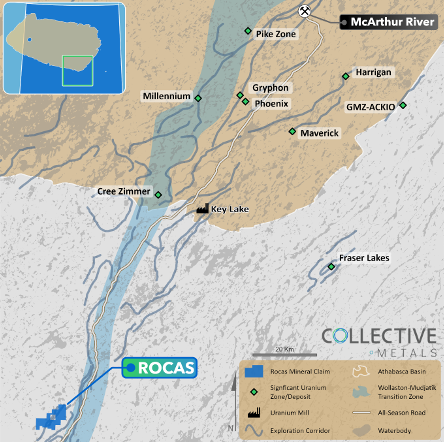
The Rocas project comprises 4,002 hectares.
75 kilometers southwest of the Key Lake Mine and Mill facilities along Highway 914, and approximately 72 kilometers south of the present-day margin of the Athabasca Basin.
The project was acquired via staking in May 2023 and recently expanded by an additional 931 hectares.
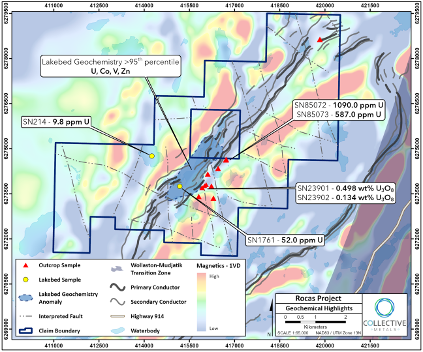
Historical airborne EM work in 2017 defined conductive trends on the Project west of and sub-parallel to the Key Lake Road shear zone, corresponding with favourable metasedimentary basement lithologies. Multiple parallel conductors, offsets, and termination points indicate the trend widening and potential cross-cutting structures.
Additionally, a 2007 field sampling program identified anomalous lakebed geochemical anomalies that statistically rank as greater than 95th percentile U, Co, V, and Zn along the conductor corridor, including high U/Th ratios.
The Standard Uranium exploration team mobilized to the Project on September 30th, 2025, to undertake a detailed mapping, prospecting, and sampling program to ground-truth historical uranium showings at surface. Collected grab samples will be transported to Saskatchewan Research Council Geoanalytical Laboratories in Saskatoon, SK for geochemical analysis.

Multiple new drill target zones have been identified on the Rocas project, outlined via the confluence of low gravity anomalies, historical surface mineralization, lakebed geochemical anomalies, EM conductors, and crosscutting fault zones.
Ongoing geophysical interpretation and modeling is planned throughout 2026 to integrate historical results with newly collected datasets, which will provide high-priority drill targets and significantly derisk the Project prior to modern drilling next year.
Get notified about the latest company news and updates by signing up below.